VISION
Clarity. Altitude. Anchored.
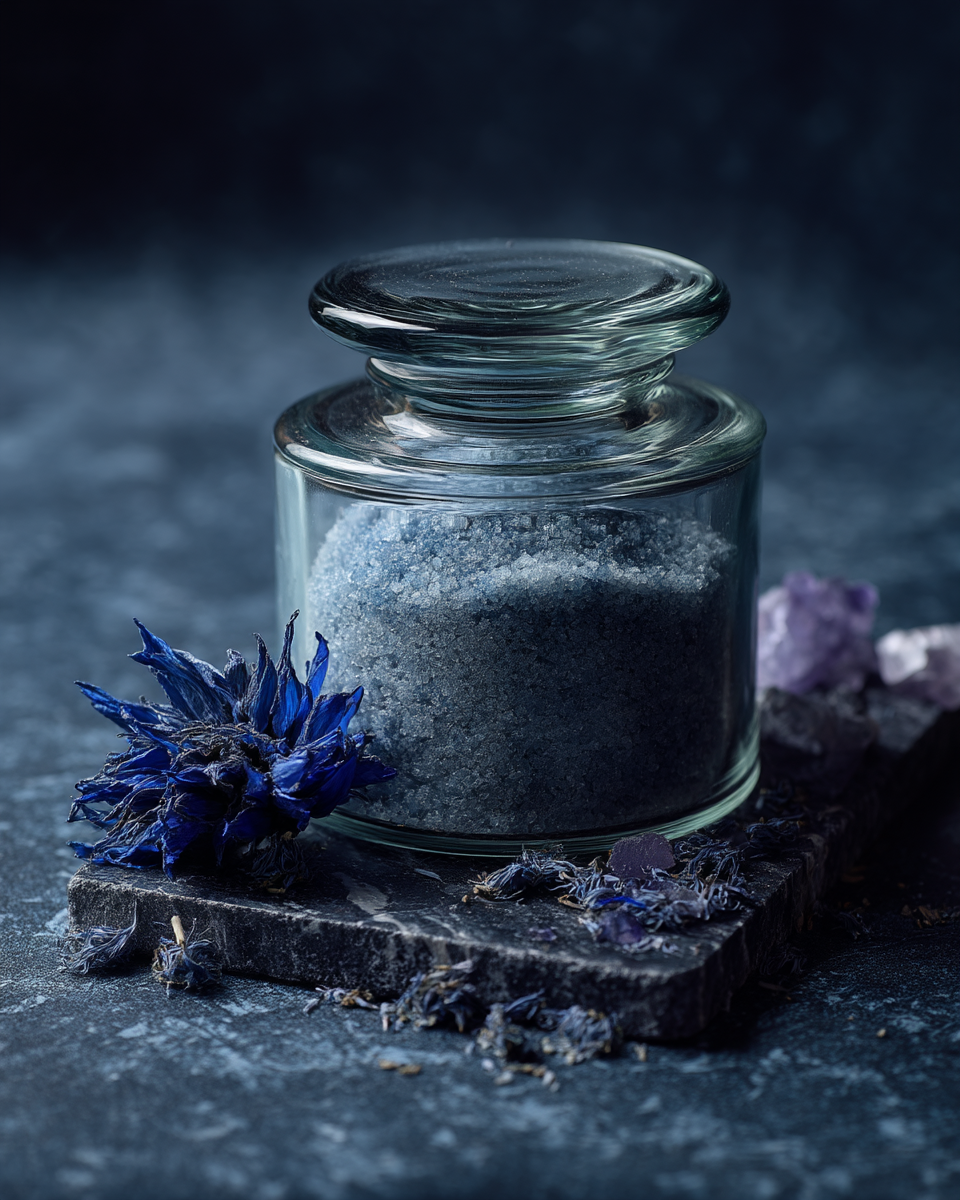

Vision is the most visually striking jar in the line. Vivid blue cornflower against grey Dead Sea salt, a gold thread of osmanthus running through it, the whole thing reading like altitude — dry, clear, grounded. The scent is cypress and frankincense and juniper berry: a coniferous, resinous blend that smells like standing on high ground after you've climbed to get there. Not aspirational. Earned.
Dead Sea salt and Epsom salt
A grey-mineral base that reads like altitude and ground in the same palette, with dendritic salt to carry the scent.
Dead Sea salt's grey-mineral character is doing something specific here — it carries the visual register of stone and high places without introducing warmth. Epsom salt lightens the base without sweetening it. Together they create a field that lets the blue cornflower read as vivid without competing. The palette is deliberate: grey ground, vivid blue, gold thread. Everything in service of clarity.
Cambrian blue clay
A rare naturally occurring clay with a blue-grey mineral color, sourced from Baltic and Russian mineral deposits. Ancient halite — salt formations hundreds of millions of years old.
Cambrian blue clay is one of the most unusual ingredients in this line. Its color is entirely natural — no dyes, no additives — formed by trace minerals in ancient halite deposits over geological time. It is mineral-conditioning and leaves no residue or staining at the concentrations used here. What it does leave is the most distinctive bathwater in the ALIVE line: a soft, clear blue-grey that looks like something between mountain water and dawn light. You will remember this bath by its color.
Blue cornflower
Centaurea cyanus — a wildflower of European grain fields, its vivid blue one of the most stable colors in dried botanicals.
Cornflower blue is one of the few botanical colors that holds through drying without fading. It has been found in the tomb of Tutankhamun — placed there over three thousand years ago, still recognizable as cornflower. There is something worth sitting with in that. In the jar it forms the primary visual statement of the line: a field of blue against grey salt that stops people before they've read a word. It belongs to this stage not just visually but in its historical association with clarity, sight, and the open sky.
Osmanthus
Osmanthus fragrans — a small cream-gold blossom native to Asia, one of the ten traditional flowers of Chinese culture. Its scent has been described as apricot, peach, and honey simultaneously.
Osmanthus is rare in Western bath products and deeply familiar in East Asian tradition — it's been used in tea, medicine, and ceremony in China for over two thousand years. The dried flowers are cream-gold, tiny, and thread through the blue cornflower field like light through water. They don't shout. They are the gold that makes the blue mean something. In the water, their stone-fruit register enters the bath quietly, underneath everything else, as a warmth you can't quite locate.
A whole blue lotus or cornflower head
Placed with intention above the botanical field. Never crushed, never mixed.
Blue lotus — Nelumbo nucifera — has been sacred in ancient Egyptian and Hindu traditions for millennia, associated with the sun, with consciousness, with what emerges from the water toward the light. A large intact cornflower head is the alternative when lotus is unavailable. Either way, the drama element here is a single gesture: something whole, placed deliberately, that belongs to the register of vision and elevation. It should feel like it was set there by someone who thought about it.
The scent blend
Nine plants — cypress, frankincense, juniper berry, bergamot, lavender, clary sage, jasmine absolute, sandalwood, and labdanum — carried in a plant-derived base.
Cypress leads — dry, coniferous, the scent of altitude. It is the most reformulated blend in the line, and cypress is the reason: this is what Vision smells like now. Not medicinal, not sharp — green and dry and high. Frankincense grounds it with a deep resinous anchor, the same presence it has carried in sacred spaces across cultures for five thousand years. Juniper berry amplifies the cypress direction, adding a dry-green body that extends the high-country register. Bergamot lifts the top just enough to prevent the blend from tipping too heavy. Lavender is deliberately kept low here — a quiet presence that protects the distinction from Let Go, which lavender owns. Clary sage is a ghost note, barely there, a hint of something euphoric and herbal beneath the conifer. Jasmine absolute arrives in the dry-down as a softener — its job here is not to be jasmine but to keep the blend from reading austere. Sandalwood and labdanum anchor the base, slowing the evaporation and deepening the frankincense. This blend needs time. Allow twenty-four hours after it opens before you decide what you think of it.
Clear quartz
One of the most common minerals on earth, and one of the most consistently kept close.
Clear quartz in a blue jar catches light differently than it does anywhere else in the line. It is the same stone. The context changes what you notice.
Amethyst
A violet variety of quartz, its color shaped by iron and natural irradiation. One of the most widely used stones in human history across every inhabited continent.
Amethyst and cornflower share the same blue-violet family — placing amethyst in this jar isn't decoration, it's coherence. The stone reads as an extension of the botanical, not an addition to it. Amethyst has been associated across many traditions with clarity of mind, with seeing through rather than around. Ancient Greeks placed it in drinking vessels. Medieval European scholars wore it for focus. The tradition of keeping it close when you need to think clearly is older than most of our institutions. It asks nothing of you except that you notice it.
Iolite
A magnesium iron silicate with a distinctive blue-violet color that shifts with the angle of light. Viking navigators used thin slices of iolite as polarizing filters to locate the sun through cloud cover.
Iolite is the most intentional stone in the ALIVE line. Its historical use as a navigational tool — a way of finding direction when the sky obscures it — places it precisely in the register of vision and orientation. It is also genuinely rare, and it looks it. In the jar, it reads as something a person placed there with knowledge of what they were doing. Which is exactly what happened.
Full ingredient list
Magnesium Sulfate, Sodium Chloride (Dead Sea), Cambrian Blue Clay, Centaurea Cyanus Flower, Osmanthus Fragrans Flower, Nelumbo Nucifera Flower, Cupressus Sempervirens Oil, Boswellia Carterii Oil, Juniperus Communis Fruit Oil, Citrus Bergamia Peel Oil (FCF), Lavandula Angustifolia Oil, Salvia Sclarea Oil, Jasminum Grandiflorum Flower Extract, Santalum Album Wood Oil, Cistus Ladaniferus Resin.