EMBODY
Integration. Anchoring. Return.
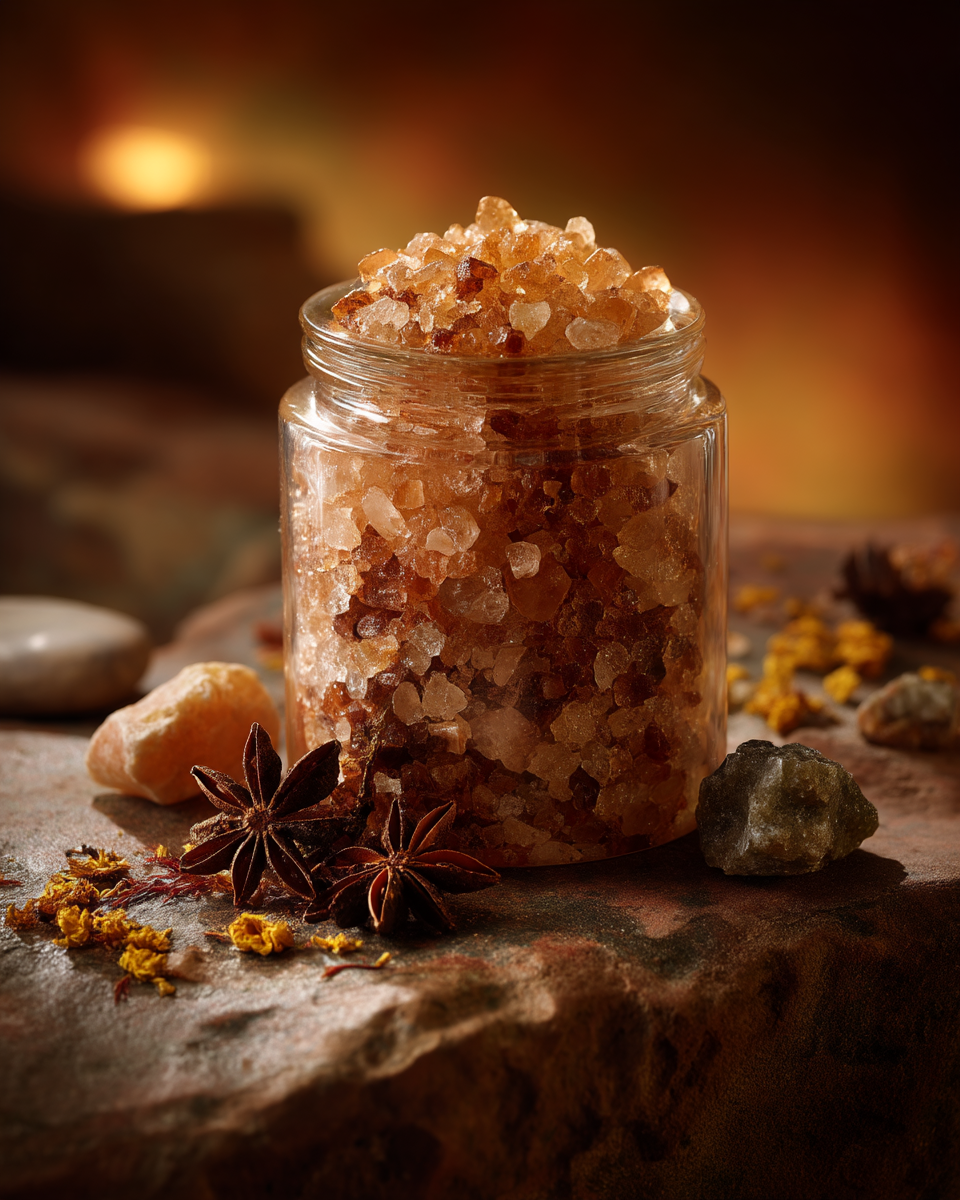
This is the heaviest jar in the line — in weight, in color, in scent. Embody is the completion bath. The palette is warm earth: grey Dead Sea salt scattered with terracotta Himalayan crystals, amber calendula, deep red-orange safflower, star anise nestled among the botanicals like something placed there by a careful hand. The water turns warm terracotta-amber. The scent is sweet orange over vanilla and cedarwood — bright on top, slow and grounded underneath. This is what it feels like to land.
Dead Sea salt and Himalayan pink salt
A coarse grey mineral dominant with individual terracotta crystals scattered through it, and dendritic salt to carry the scent.
Dead Sea salt at coarse grain is geological — heavy, textured, grey-tan. The Himalayan pink is an accent, not a base: individual terracotta-pink crystals catching the light among the grey. This is not a pink salt blend. It is a grey salt blend with warmth threaded through it, which is a different thing entirely and the reason the jar reads as grounded rather than decorative. The coarse grain matters — do not substitute fine. The weight of it in the hand is part of what this blend is.
Red kaolin clay
A naturally iron-rich kaolin clay, its warm terracotta color entirely mineral in origin.
Red kaolin deepens the terracotta register of the Himalayan crystals into something continuous — salt, clay, and stone all in the same warm-earth family. It is skin-softening and gentle. In the water it contributes to the warm amber-terracotta color that defines this bath. The cross-layer coherence here — red clay, pink Himalayan, carnelian stone, safflower petal — is not accidental. Everything in this jar is in conversation with everything else.
Calendula
Calendula officinalis — the pot marigold, cultivated as a healing plant across Europe and the Mediterranean for centuries.
Calendula appears in both Immerse and Embody — but its role here is different. In Immerse it threads warmth through a cooler field. Here it is the dominant botanical, the warm amber-gold ground that everything else sits on. It is one of the most well-documented skin-soothing plants in Western herbal tradition. In the water it releases its color and its warmth. It has been a healer's plant for a very long time, and it carries that history quietly into this bath.
Safflower
Carthamus tinctorius — one of humanity's oldest cultivated plants, grown for dye, oil, and medicine for over four thousand years across Asia, the Middle East, and Africa.
Safflower petals are deep red-orange — a color contrast against the amber calendula that creates visual depth in the jar. In the water they release a warm terracotta tint that joins the red kaolin. Safflower has been found in ancient Egyptian tombs used as a textile dye. It has colored the robes of Buddhist monks. It is a plant with an extraordinarily long relationship with human beings, and its pigment is still doing its work here, in this jar, in your bath. There may be a light ring — this is safflower being safflower.
Star anise
Illicium verum — a small evergreen tree native to southern China and northern Vietnam. The star-shaped fruit is one of the most geometrically perfect forms in the plant kingdom.
Three to five star anise pods are nestled among the calendula and safflower — not placed on top, but among. They are deep brown and eight-pointed and architectural. They look like something a person put there deliberately, because they are. Star anise has been used in traditional Chinese medicine and culinary tradition for centuries. Its spice-warmth register echoes the vanilla and sweet orange in the scent without being in the formula itself. It is the drama element that bridges the botanical field and the scent world. It should feel like a symbol. It is one.
The scent blend
Five plants — sweet orange, cedarwood, ho wood, vanilla oleoresin, and ylang ylang — carried in a plant-derived base.
Sweet orange opens this blend with a brightness that surprises against the heavy base — 28% of the formula, the highest proportion of any single note in the line. It is the contrast that makes the depth readable: without that opening brightness, the vanilla and cedarwood would be beautiful but heavy. Cedarwood and ho wood form the structural base — dry, woody, grounded. They separate this blend from Immerse, which uses the same woods with a different emotional register. Here they are warm, not still. Vanilla oleoresin is the defining presence of this blend — not sweet in a confected way, but slow and warm and deeply grounding, the way a room smells when someone has been comfortable in it for a long time. Ylang ylang adds a creamy floral layer that binds the citrus to the vanilla. These two together on warm skin can tip quickly into excess, so they are held carefully in balance. This is the blend that people find most immediately appealing. That is worth knowing — and also worth noting that embodiment is completion, not the brand's destination. It is the closing of a circle, not an arrival at sweetness.
Clear quartz
One of the most common minerals on earth, and one of the most consistently kept close.
Clear quartz is in every blend in the line. It is the constant — the stone that belongs to all stages. In Embody, surrounded by warm earth tones, it catches light differently than it does in Vision's blue field or Arrive's pale salt. The same stone, seen from the other side of the arc.
Carnelian
A deep red-orange variety of chalcedony, its color shaped by iron oxide. One of the oldest stones used ornamentally by human beings — found in Neolithic graves, ancient Egyptian amulets, and across nearly every ancient culture.
Carnelian echoes safflower and the Himalayan accent crystals — same color family, different material. It has been carried as a grounding, vitalizing stone across traditions from ancient Egypt to Ayurvedic practice. It is warm in the hand in a way that cool stones aren't. It belongs at the end of the arc, where the work is integration rather than release or clarity. It is the stone you hold when you're ready to be back in your body.
Pyrite
Iron sulfide — fool's gold — formed in sedimentary rock under conditions of low oxygen. Its metallic gold luster is one of the most distinctive surfaces in the mineral world.
Pyrite is the unexpected stone in this line. It doesn't look like the others — it looks industrial, metallic, almost out of place among the warm botanicals. That tension is the point. Pyrite echoes the vanilla oleoresin's depth in a different register: earth and fire. It has been associated in many traditions with vitality and the capacity to act from a grounded place. In the jar it catches the light like something that knows its own worth. After you've arrived, let go, immersed, and seen — pyrite is the stone that says: now what will you do with it.
Full ingredient list
Sodium Chloride (Dead Sea), Sodium Chloride (Himalayan), Kaolin (Red), Calendula Officinalis Flower, Carthamus Tinctorius Flower, Illicium Verum Fruit, Citrus Sinensis Peel Oil, Cedrus Atlantica Wood Oil, Cinnamomum Camphora Wood Oil, Vanilla Planifolia Fruit Extract, Cananga Odorata Flower Oil.